
Some financial service providers are still debating whether they need a presence on the social web at all. A few already have a confident presence that creates value for both their customers and their business.
A new study looks at the qualitative and quantitative differences across the financial industry and examines success on social networks. Deutsche Bank stands out for the quality of its presence, while in quantitative terms it only comes third (first place: Commerzbank, second place: DZ Bank). (Source: Anxo Financial Services study)
But what do “quantitative” and “qualitative” actually mean when it comes to social media? Which metrics really matter?
In qualitative terms, financial service providers differ above all in how they communicate with their fans and followers. The dialogue happens “in real time” and creates a strong customer focus. As a result, these providers are close to the market and can spot critical discussions with a degree of empathy and step in. This comes from a clear strategy that builds lasting trust, above all through transparency, openness and honesty. Service and process innovations that meet real needs then create value for customers, which in turn benefits the company too!
Yet here, too, there is untapped potential. What stands out is that hardly anyone uses synergies. Many companies did not even use social media elements to link their own website to their social networks.
The reason is obvious. Social media is built on dialogue between people, which creates a lot of momentum. Many corporate websites, by contrast, are static. Users leave an engaging discussion to follow a recommendation. They expect more information and want to share it with their friends and contacts, but they end up on pages that stick to one-way communication !
That is why the dusty old blog is attracting fresh interest. It is quick to set up, inexpensive and lets you continue and expand the dialogue with your customers. It gives customers in-depth expertise and creates value that builds loyalty. The following chart shows once more how customers’ use of the individual portals relates to your own blog.
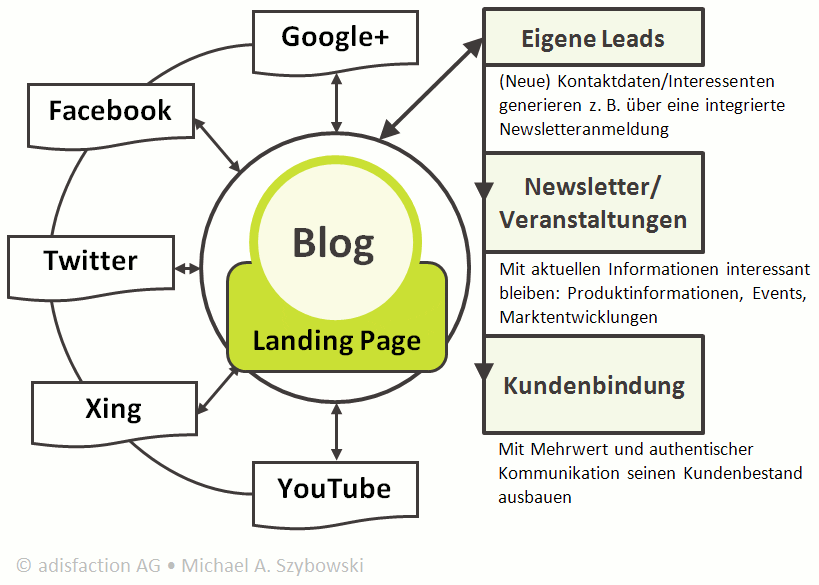
The blog therefore serves as the central hub of a social media strategy, linking all portals to your own website (the landing page in the chart). Customers can also discover other channels and gain extra value, provided the various portals are clearly differentiated in strategic terms (which again shows how important a clear strategy is). What matters most, though, is using the traffic on social networks to build your own traffic on your own platforms. That traffic should then be converted into your own leads, and a newsletter is ideal for this. A newsletter lets you capture a customer’s first contact details, such as their name and email address. Authentic communication, exclusive information and special offers then build the customer’s loyalty to the company or brand. Over time, you can collect more data and grow your customer base.
Traffic means the visits a website receives. The more traffic, the more important and popular a website is. Can this quantitative measure also be a qualitative factor for a company’s presence on a social media platform? Is a Facebook fan page, for example, more successful the bigger its fan community?
One thing is certain: without fans there is no dialogue, and without interaction there is no added value. Traffic is therefore one of the factors that decide success on the social web. But here, too, you need to look closely at the traffic.
Competitions are a popular way of generating traffic. Usually, trendy products are given away, and the page quickly gains a growing fan community. But that has less to do with genuine interest in the company or brand than with the hope of winning something without any real involvement. Yet the real aim of any social media activity is to interact with users and spark their involvement with the product or company. That is exactly why the very high initial interaction fades away, namely as soon as the winners are announced (source: “adisfaction-Trendreport: Social Media für Emittenten 01/2012”, adisfaction AG, January 2012). So you could say that the new fans tend to be of rather poor quality. The conclusion is that quantity alone is not enough to judge the success of a social media activity. Quantity also has to be checked and assessed for its quality.
To sum up, we can also point to DZ Bank’s rapid growth, in line with the Anxo study, but it always needs a closer look. In qualitative terms, Deutsche Bank is rightly singled out, as it is very authentic and exclusive in its social web activities. But even here there is untapped potential, so other financial service providers can still start catching up. Perhaps from now on we should keep an eye on the download rates of blogging services?!


