

This blog article sums up the key points of our “White Paper: Which provider is right for my project?”. For the full details, feel free to download it.
Contents
- What is server-side tracking?
- Who is server-side tracking relevant for?
- The benefits of server-side tracking
- Server-side tracking providers
- Comparing the users captured
- The role of server-side tracking in the future of web analytics
- Conclusion
In digital marketing, the accurate collection and analysis of user data is crucial to the success of online marketing campaigns. But as data protection grows in importance and privacy rules become ever stricter, collecting accurate and meaningful data is getting harder. This is where server-side tracking comes in: a technology that captures data more precisely while also improving privacy.
Original image from jentis.com
What is server-side tracking?
Server-side tracking (SST) is an alternative to conventional client-side tracking, where tracking code runs on the user’s side, in the web browser. SST works on the server side, which makes data collection more accurate and improves user privacy at the same time.
With client-side tracking, data is collected and processed on the user’s device. With SST, the data is collected and processed on the website operator’s server. This means the data is not stored on the user’s device, which protects the user’s privacy and makes data collection more accurate.
Who is server-side tracking relevant for?
Server-side tracking is particularly relevant for website operators who actively work with the data their website collects. With data protection rules on the rise, such as the General Data Protection Regulation (GDPR) and the privacy measures from Apple and other providers, it is more important than ever to use a technology that delivers precise data and protects privacy.
This matters most for companies that run digital marketing campaigns and rely on accurate, meaningful data to optimise their campaigns and maximise ROI (return on investment). SST lets these companies collect accurate data on how their users behave without invading their privacy.
Image source: jentis.com
The benefits of server-side tracking
Server-side tracking offers a number of advantages over traditional client-side tracking. They include:
- Anonymised user data: SST makes it possible to anonymise or pseudonymise user data before it is processed or stored. You can track user behaviour without invading the user’s privacy.
- Better performance: Because tracking and data processing take place on the server, the performance of the user’s device is not affected. This improves the user experience and can have a positive effect on SEO.
- Choice of server location: With SST, the operator is free to choose where the server is located. This can help keep data transfer times to a minimum and ensure that data is stored under a specific legal jurisdiction.
- Data ownership: With client-side tracking, data is stored on the user’s device. SST lets the website operator store and control the data instead. The operator has full control over the data collected and can manage it as needed.
Server-side tracking providers
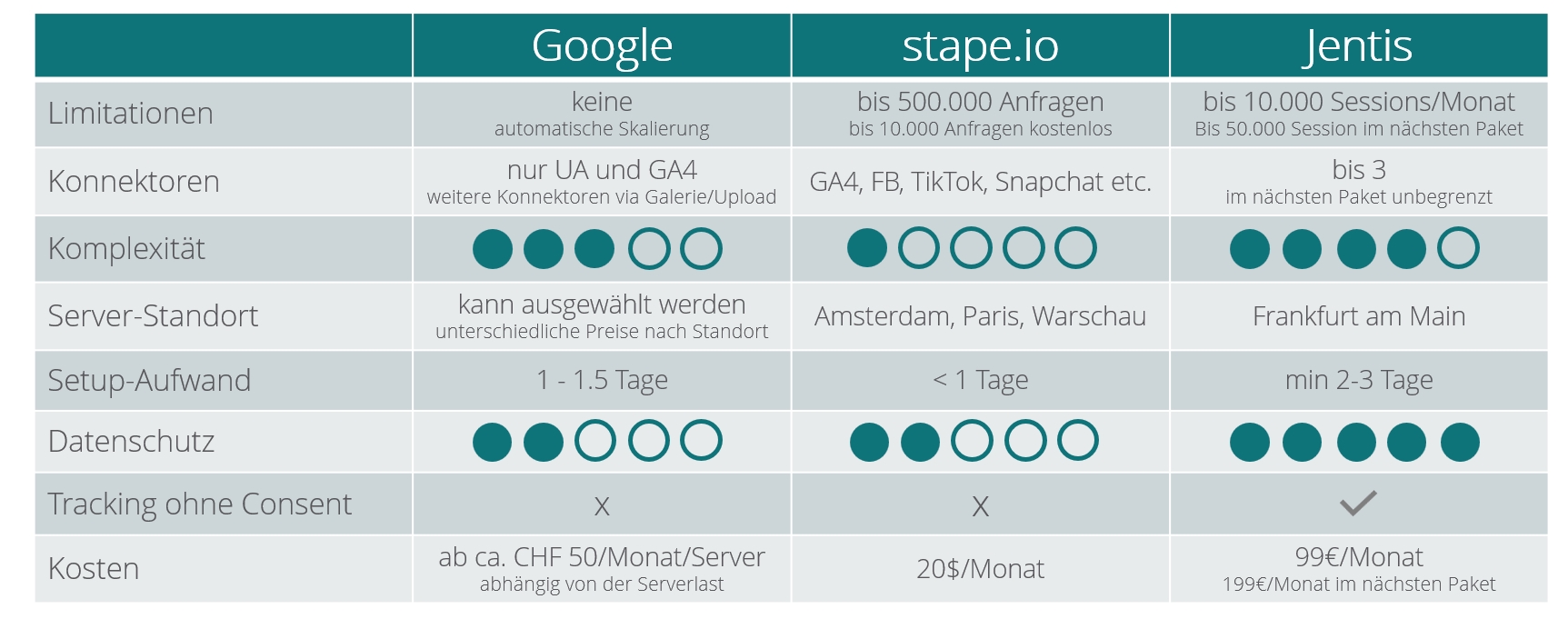
There are several SST providers, including Google, stape.io, Adobe and Jentis. Each takes its own approach and puts a different emphasis on data processing, server location and privacy.
In this article, we focus on tag manager solutions that leave you free to choose your analytics solution (Adobe, Matomo, Google Analytics and so on). If you would like more information on other providers, you will find it in our white paper.
Google server-side tracking is a good choice if you already work with Google Tag Manager. It offers a fast and cost-efficient way to introduce SST, but the data collected can be read by Google or other organisations.
Stape.io offers a user-friendly solution for SST, although the choice of server locations is limited.
Jentis, an Austrian provider, offers a privacy-compliant solution for SST that meets GDPR requirements. Jentis’s servers are located entirely within the EU, and the provider has its own tag manager, which has to be used instead of GTM.
Choosing the right tool depends on the specific requirements and goals of your project.
Comparing the users captured
User counts can vary depending on the tool you choose. In general, server-side tracking captures more users than client-side tracking. Differences can be explained by privacy measures such as Apple’s ITP and cookie blockers. Thanks to its twin-server technology and the option of being loaded as “essential” in the consent manager, Jentis captures more users than other tools.
For the comparison, we set up all the tools on the same website and compared the users they captured over a period of time to document any differences. One thing stands out immediately: “regular users” (client-side tracking) captured significantly fewer users than server-side tracking. Jentis captured slightly more users again.
The role of server-side tracking in the future of web analytics
With data protection rules increasing and privacy becoming ever more important, SST is likely to play an increasingly important role in web analytics. It enables more accurate data collection while improving privacy, which makes it an attractive option for companies that rely on accurate data to optimise their online marketing campaigns.
SST also gives you better control over the data collected. That makes it attractive for companies that want to retain ownership of their data and make sure their data is secure and stored in line with data protection rules.
Conclusion
Using server-side tracking and moving cookie storage to the server increases the number of users and events captured, because device restrictions (ITP, ad blockers, cookie blockers) have almost no effect on server-side tracking. Data quality also improves significantly, as these blocking tools lose their impact too.
Consent management is another challenge. If a user decides against tracking, no tags are loaded and no data is processed. Alongside ad blockers, this is a second hurdle, this time on the website side. So there are two significant hurdles to overcome before data can be captured from a user and processed: blocking technologies (on the user’s device) and consent management systems (on the website).
If you do not want to rely on the user’s “goodwill” and depend on the data you capture, Jentis is a very good alternative. Because it collects data through a twin server, Jentis can be listed as “essential” in the consent management system. It may therefore always be loaded and process data, regardless of the consent the user has chosen. This gives marketing managers back the ability to make decisions based on the data they collect.
Even with a simpler server-side tracking solution from Google, stape.io or other providers, you are already in a much stronger position than with regular client-side tracking. Google in particular is working to bring users who refuse consent back into its statistics through data extrapolation. For these calculations, however, the underlying base (the quantity and quality of consent acceptances) is decisive.
You can find more information about our server-side tracking services on this page.


