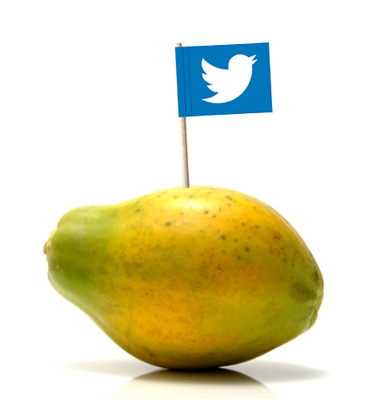
Twitter advertising is like papayas: a little exotic, rarely on the shopping list and popular mainly with people who like something special and out of the ordinary. So far, papayas have not enjoyed a career anything like the banana’s. Bananas are the second most popular fruit in Germany, after the home-grown apple. Will Twitter advertising be just as successful on its way into the mainstream of the online media mix? Given the growing interest in Twitter as an advertising platform, and the short messaging service’s growing efforts to go from exotic papaya to everyday banana for advertisers, it is worth taking a closer look at the present and future of Twitter advertising.
Twitter ads: what is possible today?
Where Twitter does make money, it is mainly in the US (and perhaps in other English-speaking countries). There, campaigns can be booked through a self-service platform, much like Google AdWords. Anyone with an English-language channel and a US credit card can book Promoted Tweets and Promoted Accounts.
Promoted Tweets are like regular short messages, but they carry a “Sponsored” label and achieve greater reach. They appear in followers’ timelines, for users of similar accounts, in relevant searches and when people click on hashtags contained in the Promoted Tweet. Targeting is possible by
- gender
- location
- device
- email address
- cookie ID
- TV spots (Twitter tracks TV programmes and ad breaks. When users tweet about a programme, Twitter serves them tweets from the TV advertisers. Twitter calls this “TV conversation targeting”.)
Promoted Accounts are promoted by Twitter in its own recommendation service. You pay for each follower gained.
Advertisers who want to go further than these formats can use Promoted Trends to sponsor an entire topic. Format and placement are similar to a Promoted Tweet, but:
- Instead of a single message, all tweets on a trend are promoted. That takes quite a bit of budget.
- Promoted Trends cannot be booked through the self-service platform.
Incidentally, Twitter users often reject Promoted Trends when they are used purely as an advertising tool. Reactions range from gentle teasing to outright abuse.
The same ad formats can be booked in Germany, but the self-service platform is not yet available. That is why ad accounts here are only set up from EUR 15,000 for the first three months.
Twitter ads have been, and continue to be, part of successful campaigns. The short messaging service publishes a number of case studies on its business site as “Success Stories”. You will look in vain for examples from Germany there.
We described our own first steps with Twitter ads on this blog a few months ago. A lot has happened since then. First, alongside its semi-successful IPO, Twitter has realised that it needs to improve. And second, we have since gained experience from a number of client campaigns we have managed, which helps us assess both existing and planned new features.
Twitter ads: what comes next?
Twitter needs to earn more money from advertising to finally become profitable. To that end, it is taking a whole range of measures, which we pick up and comment on below:
- Twitter recently went on the offensive with new formats. These include, in particular, Twitter Cards: ads with an image and CTAs such as “Install now” or “Buy now” that are designed to drive direct conversions.
> Our comment: for visually appealing products and interesting offers, this is certainly a placement with potential. With its large clickable area, it is a sure-fire traffic driver in the Twitter world. - The latest move towards a partnership with Amazon points in a similar direction. It lets users fill their shopping basket at the world’s largest online retailer by clicking in tweets.
> Our comment: probably a trial balloon that will burst very soon. - Twitter wants to grow.
> Our comment: growth in user numbers and usage intensity is essential for future success. Social networks need critical mass to survive the competition and, thanks to their reach, to qualify for the big budgets. At the moment, though, we have the impression that Twitter is cheating a little: it estimates campaign reach very generously. For example, there is no insight into frequency capping, only the information that it exists. - Multimedia content is set to make the timeline more attractive. Users will be able to attach more than one image to a tweet. Videos will also be included in search results. Twitter wants to make more use than before of the content and popularity of its own video platform, Vine.
> Our comment: high time too. Brevity is a defining feature of Twitter, but it should not be clung to dogmatically at the expense of necessary progress. - To get in touch with international brands, Twitter is aiming for partnerships with large advertising networks such as Omnicom. A look at the Twitter success stories mentioned above shows that this is the audience in focus, rather than small, regionally active companies.
> Our comment: mega deals are probably more efficient than chasing smaller budgets. But that is not how Twitter will gain street credibility in the marketing industry. - To increase its revenue in Germany, Twitter is building a powerful sales team.
> Our comment: good to know there will be flesh-and-blood contacts in future. Even better would be a German-language self-service platform at last, modelled on the American one.
Twitter ads: an interim verdict
What Twitter ads are best used for is a question that cannot yet be answered conclusively. Twitter wavers between being a dialogue channel and an information channel. Do you try to interact with user X through a promoted ad? Are Twitter ads simply becoming more like other display formats? Or do you use Twitter only to send people on to your homepage or landing page? In theory, anything goes. As a network, Twitter has not settled on a clear direction, so there cannot be a best-practice recipe yet. That makes its ad slots interesting above all for very good creative ideas that are woven into the network. But such ideas take a lot of work to develop and are naturally more “limited” than simple text and/or image ads.
For now, Twitter ads are likely to remain formats for advertisers who like to experiment. In other words, for papaya fans.